


Looking for a card game that’s easy to learn but impossible to get tired of? Discover 3-13, a game where the goal is zero and the rules change every single round, making it the perfect choice for your next family night or friends gathering. The secret to winning isn’t collecting points—it’s getting rid of them. To learn more, check out Link ABILAWA99
What keeps 3-13 fresh and exciting is its unique progressive structure. The game unfolds over eleven rounds, and with each new deal, the number of cards you hold and the identity of the wild card both change. In the first round, you’re dealt three cards, and 3s are wild. Next, there are four cards with 4s as wild, and this pattern continues all the way up to the King. This constant evolution keeps every player, new or experienced, on their toes.
Don’t let the idea of changing rules sound complicated; it’s the simple twist that makes the game so much fun. The core objective always stays the same: group your cards into simple combinations to empty your hand. If you know what a standard deck of cards is, you have all the skills needed to play.
Gathering Your Tools: What You Need for a Game of 3-13
One of the best parts of 3-13 is its flexibility with player counts. While the game truly shines with three to six people, playing with just two is also a lot of fun. So, whether it’s an intimate game night or a larger family gathering, you’re covered. The number of players simply helps determine how many decks you’ll need.
The exact number of decks is based on your group size. For a game of two to four players, two standard 52-card decks are perfect. If you have five or more players at the table, you should shuffle three decks together. This ensures there are enough cards to go around, especially in the later rounds when you’re dealt more cards.
Before you shuffle, go through your chosen decks and remove all the Jokers. The game is designed to be played using only the standard ranked cards from Ace to King. Once you’ve set the Jokers aside, give the cards a good shuffle, and you’re ready to play.
Understanding the Goal: Why the Lowest Score Wins
Unlike many card games where you’re trying to rack up points, 3-13 flips that idea on its head. Your primary objective is to finish the game with the lowest score possible. The entire game is a race to avoid collecting points. After all 11 rounds are played, the player with the lowest total is declared the winner, making every card you hold a potential liability.
The key to achieving a low score each round is to be the first player to successfully “go out.” This is the game’s central action, where you get rid of all the cards in your hand by arranging them into specific groups. The first person to accomplish this ends the round and, as a reward, scores a perfect zero.
When one player goes out, the round ends immediately for everyone else. Any cards you’re still holding are then counted up and added to your total score, which is exactly what you want to avoid. The fewer cards you have left, the better. To win, you’ll need to master two key formations: sets and runs.
How to Form Winning Groups: Sets and Runs
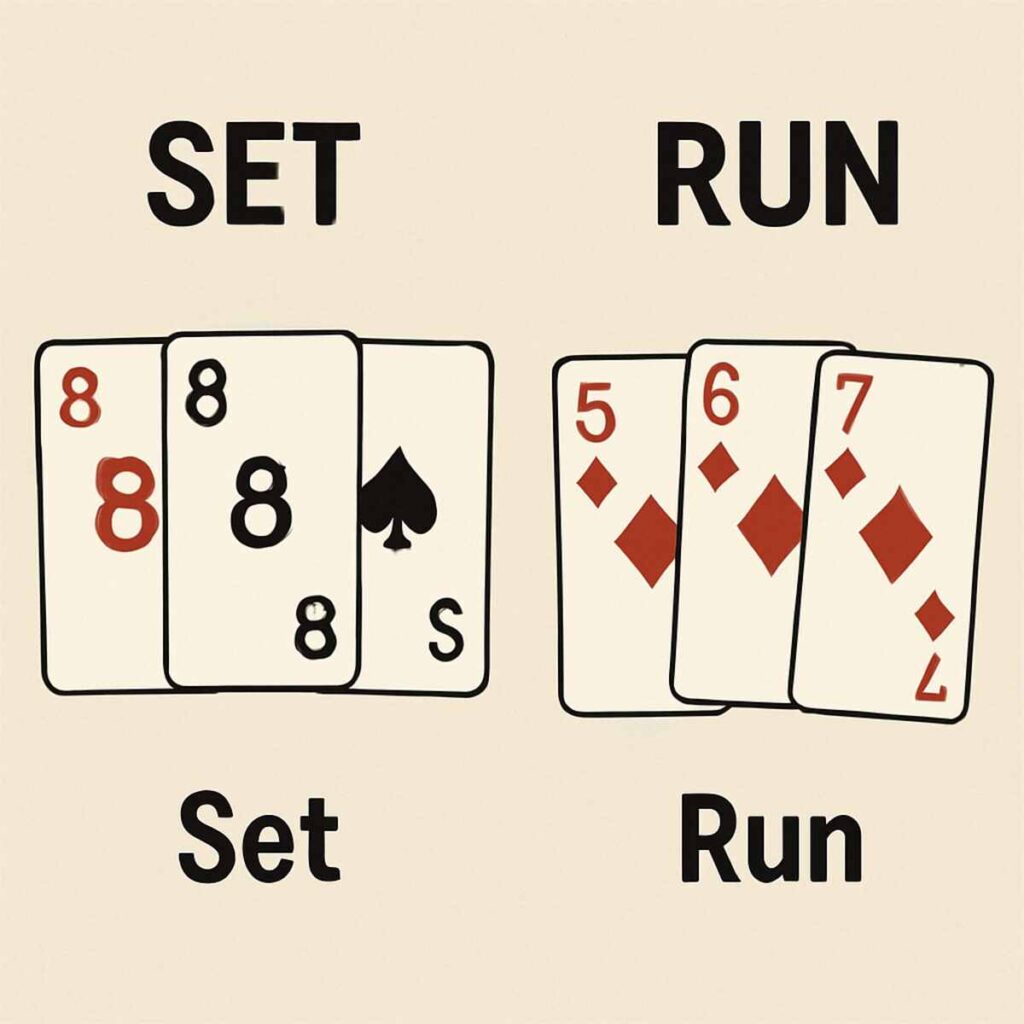
To “go out” and win a round, you must arrange all your cards into specific groups. These groups, called melds, come in just two types you need to know: Sets and Runs. Mastering the difference between them is the core of your strategy.
The first type is a Set: three or more cards of the same numerical rank. The suits don’t matter at all for a set. For instance, holding an 8 of Hearts, an 8 of Clubs, and an 8 of Spades creates a perfect Set of eights. Four Jacks or five 2s would also be valid Sets.
The second type is a Run: three or more cards in sequential order, like a 5-6-7. The crucial rule for a Run is that all cards must belong to the same suit. A 5, 6, and 7 of Diamonds is a valid Run; a 5-6-7 of mixed suits is not.
So, Sets match rank while Runs match suit and sequence. But what if you’re missing just one card to complete your group? This is where the game introduces its most powerful tool: the wild card.
The 3-13 Twist: How the Wild Card Changes Every Round
The secret to completing those Sets and Runs when you’re just one card short is the game’s most exciting feature: the progressive wild card. The round number determines which card rank becomes wild, meaning it can substitute for any other card you need.
Using a wild card is simple. For example, if you’re in the “7” round, all 7s are wild. If you hold two Kings and a 7, you can use the 7 as a third King to complete your Set. Similarly, if you have the Jack and Queen of Spades, a 7 can act as the 10 of Spades to finish your Run. A wild card is a chameleon, becoming whatever you need it to be.
This dynamic rule is what makes the challenge evolve each time the cards are dealt. The pattern is easy to follow:
- Round 1 (3 cards dealt): 3s are wild.
- Round 2 (4 cards dealt): 4s are wild.
- Round 3 (5 cards dealt): 5s are wild… and so on, all the way to the King round!
But there’s a catch. While wild cards are incredibly helpful, they’re risky to hold onto. If another player goes out and you’re caught with a wild card still in your hand, it adds a hefty 20 points to your score.
Let’s Begin: How to Deal for the First Round
Starting a game is quick and easy. First, choose a dealer. A simple way to do this is to have each player draw one card from a shuffled deck; the person who draws the lowest card gets to deal first, with Aces counting as low. After the dealer is chosen, they shuffle all cards thoroughly to prepare for the first hand.
The dealer then passes out the cards one at a time, moving clockwise around the table. Since the game starts with the “3” round, each player receives exactly three cards. In the next round, the dealer will give out four cards, and so on.
Once all the cards are dealt, place the remaining deck face down in the centre of the playing area to form the draw pile. The dealer then takes the top card from this stack and places it face-up right beside it. This single, face-up card creates the discard pile. With the cards dealt and both piles established, the first player can take their turn.
What to Do on Your Turn: The Simple 3-Step Flow of Play
The player to the left of the dealer kicks things off. From this point on, every player’s turn follows the same simple, three-step sequence:
- Draw a Card: Take one card into your hand.
- Meld (Optional): Lay down your card groups if you’re ready to win the round.
- Discard a Card: Place one card from your hand onto the discard pile.
Each turn begins with a choice. You must draw one card, either the top, face-down card from the draw pile (a mystery!) or the top, face-up card from the discard pile (a known quantity!). This decision is a core part of the game’s strategy. After drawing, your turn must always end by discarding one card from your hand face-up onto the discard pile for the next player to see.
That middle step, “Meld,” is what you’ve been working toward. Melding is the act of laying down all your cards at once in their completed sets and runs. You only take this step when you can form valid groups with all the cards in your hand, which is known as going out. This sets the rhythm for the entire game, leading up to the exciting moment when a player can finally lay their hand down and win the round.
The ‘Going Out’ Moment: How to Win a Round
The entire game builds toward one exciting moment: going out. To win a round, you must be able to arrange your entire hand into valid sets and runs. But there’s a small, critical catch: you must have one card left over to place on the discard pile. Your turn isn’t complete without a discard, so you can’t use every single card in your melds. You lay down all your completed groups, then officially end your victorious turn by discarding that final, leftover card.
When you successfully go out, you’ve locked in a score of zero for the round. The action isn’t over for everyone else, however. Once a player goes out, every other player gets one last turn. This is their final chance to reduce the number of points they’ll be stuck with.
During this final turn, players can lay down any complete melds that they have in their own hands. They can even add to the sets and runs the original player just put on the table. For example, if the player who went out laid down a set of three 8s, and you have the fourth 8, you can add it to their set. The goal is simple: get as many cards out of your hand and onto the table as possible.
Anything left in a player’s hand after this final opportunity is counted as points against them. This “last chance” rule keeps every round competitive right up to the very end, as players scramble to shed points.
How Scoring Works (And How to Keep It Low)
After a player goes out, everyone else totals the points from the cards left in their hand. The player who successfully goes out automatically scores a perfect zero for the round. For everyone else, it’s time to tally up what you couldn’t meld. Knowing the high-point cards is crucial for managing your hand.
Figuring out your score is a straightforward process. Each card has a specific point value, with a major penalty for holding onto Aces or the round’s wild card. Keep this list handy:
- Cards 2-10: Face Value (a 2 is worth 2 points, a 9 is worth 9 points)
- Face Cards (Jack, Queen, King): 10 points each
- Aces: 15 points each
- Wild Cards (for that round): 20 points each
That 20-point penalty for a wild card is the one to watch out for. While wild cards are your best friends for making melds, they become your biggest liability if you get caught holding one. This scoring is repeated at the conclusion of each hand. Players keep a running total of their points, and after the final King round, the player with the lowest overall score wins the game.
Playing a Full Game: The Journey Through All 11 Rounds
The game isn’t over after just one player goes out; that’s just the beginning. 3-13 is played over eleven rounds, creating a fun arc that builds in complexity with each hand. After scoring is complete for the 3-card round, the deal passes to the player on the left. This new dealer shuffles all cards together and prepares for the next round, where both the hand size and the rules get a little bigger.
This steady progression is the heart of the game. For the second round, the dealer gives everyone four cards, and all 4s are wild. The next round? Five cards are dealt, and 5s are wild. This pattern continues all the way up to the epic final round where 13 cards are dealt, and Kings are wild.
At the end of each round, you’ll add your new score to your running total. The game officially concludes after the final, challenging King round is scored. At this point, all players compare their grand totals from every hand played. The person with the lowest cumulative score after all eleven rounds is crowned the winner!
Your 3-13 Rulebook: Common Questions
As you play, certain situations will inevitably pop up. What happens when two people want the same discarded card? The answer lies in turn priority. The player whose turn it is always gets the first right to take the top card from the discard pile. If they decide they don’t want it and choose to draw from the deck instead, the card then becomes available for other players to claim.
This is where the “buying” rule comes into play. If the active player passes on the discard, any other player can “buy” that card out of turn. To do so, you must also draw an extra penalty card from the top of the stock pile. So, you get the card you want, but you also add a random, unknown card to your hand. Your turn is then skipped for that round. If multiple people want to buy the same card, the person closest to the dealer’s left gets priority.
Another frequent question centers on the Ace. Where does it fit in a run? The Ace is a flexible card that can be used as either the lowest card (as in an Ace-2-3 sequence) or the highest card (as in a Queen-King-Ace sequence). However, it cannot “wrap around”—a King-Ace-2 combination is not a valid run. This dual role makes the Ace a powerful card, but you must use it at one end of a sequence or the other. Knowing when to buy a card—and when to let it go—adds a simple but engaging layer of strategy.
3-13 vs. Phase 10: Which Rummy-Style Game is for You?
If the structure of 3-13 sounds familiar, you might be thinking of Phase 10. While both are excellent group games, they have key differences that might make one a better fit for your game night. The most immediate distinction is accessibility; 3-13 is played with standard card decks you probably already own. In contrast, Phase 10 requires its own special, custom deck.
The gameplay itself also presents a major choice between flexibility and structure. In 3-13, your goal each round is simply to form any combination of sets and runs. Phase 10, however, is a “fixed phase” game, meaning you must complete a specific, pre-determined combination (like “one set of 3 and one run of 4”) to advance. This makes 3-13 more adaptable from hand to hand, while Phase 10 presents a more rigid puzzle to solve.
Perhaps the biggest factor is player progression. In 3-13, everyone advances to the next round together, regardless of who “went out.” This keeps the entire group on the same page and ensures no one gets left behind. In Phase 10, players who fail to complete their phase are stuck, while others move ahead, which can create a large gap in player experience over the course of the game.
You’re Ready to Play! Your 3-13 Quick-Start Cheat Sheet
Just a few minutes ago, a game where the rules change every round might have seemed complicated. Now, you have a solid grasp of how to deal, draw, and win a round of 3-13. To help you get started, keep this quick “cheat sheet” handy. It covers the core rules you’ll need as you play.
3-13 Card Game: Quick Reference
- Game Goal: End with the lowest score!
- Your Turn: 1. Draw one card (from the deck or discard pile), then 2. Discard one card.
- Wild Card: The round number is the wild card (in the “4” round, all 4s are wild).
- Scoring: Cards left in your hand are points. Number cards = face value, Face cards = 10, Aces = 15, and Wilds = 20.
- Going Out: When you can form all your cards into sets or runs, discard your last card to “go out” and score zero for that round.
The game follows a simple, repeating cycle: deal, play, score, and start the next round with a new twist. The best way to learn is by doing. So grab a deck, gather your players, and deal three cards each. Your first round is waiting.